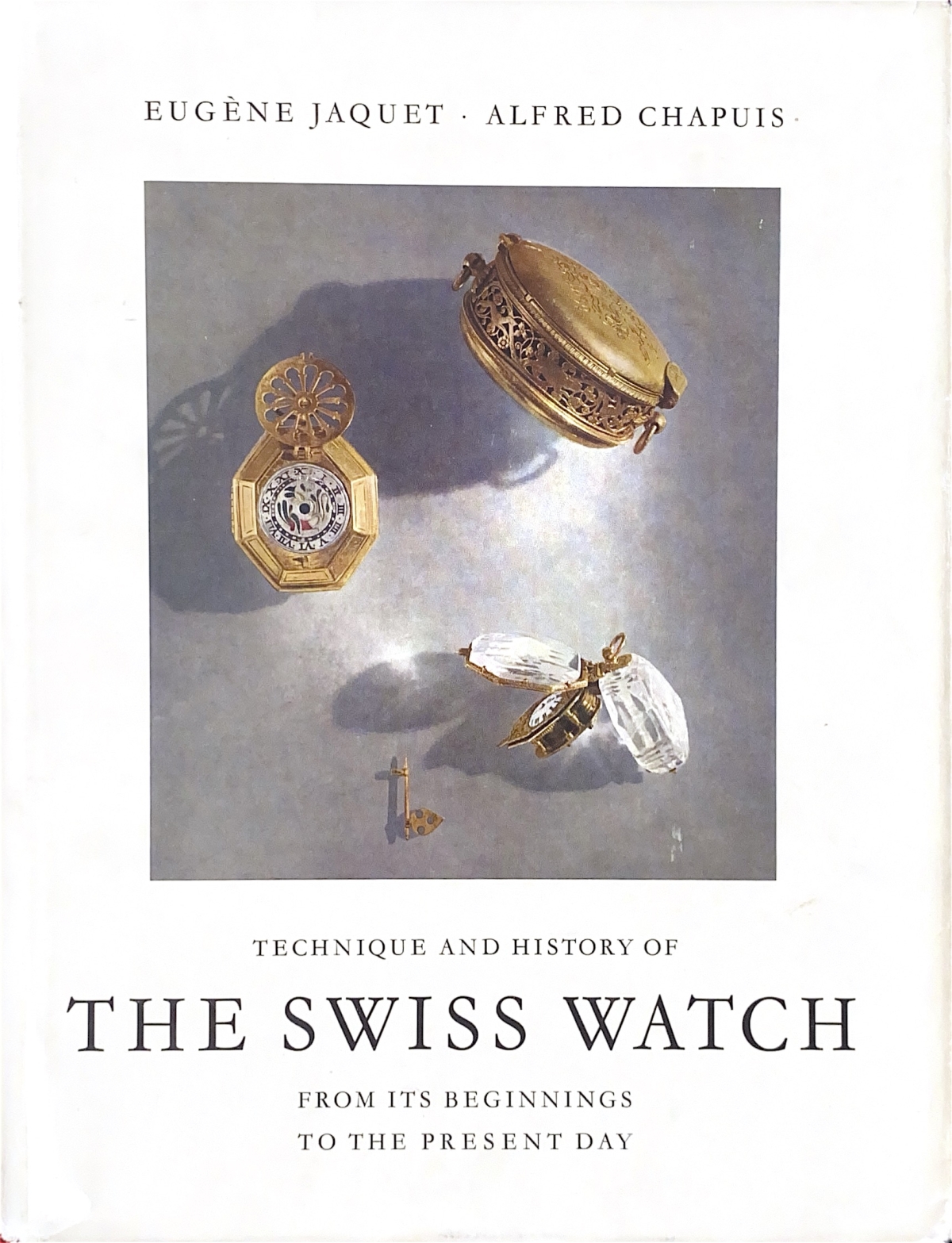
1261 - Technique and History of the Swiss Watch
CHAPUIS A./JAQUET E.ENGLISH ORIGINAL TRANSLATION OF THIS IMPORTANT BOOK - 278 pages
This book reviews the evolution of watchmaking in Switzerland from the 16th century until the publication of this work in 1945. The many production sites are described, as well as the countless trades involved in making our timepieces. In the chapter on watch decoration, all parts are amply presented. A whole section is devoted to trade relations since the beginnings of watch exports, notably with Europe, Persia, India, China, Japan, the various Americas, Africa, Australia and New Zealand. The types of watches are detailed from Roskopf to tourbillons, to extra-flat watches, wristwatches, various complications. There is a section on chronometry, competitions, the various observatories and the field of precision. And this is just a summary!
How can one resist such an anthology of the realities of Swiss watchmaking, which form the basis on which everything that exists and develops today rests?
Table of Contents :
Preface
Chap. I The beginnings of watch-making in Switzerland
- The introduction of watch-making in Geneva
- Characteristics of the watches of the sixteenth and seventeenth centuries
- The work of the Genevese watch-makers of the sixteenth and seventeenth centuries
- Enamels
- The first watches in some other Swiss towns
- The masterpieces
Chap. II The introduction of the watch industry to the Jura, and its development
- The town of Neuchâtel
- La Neuveville
- The mountains: Le Locle, La Chaux-de-Fonds, etc.
- The Val-de-Travers
- The Val-de-Ruz
- Causes of the development of watch-making in Neuchâtel
- The Bernese Jura: L'Erguel (the Valley of St-Imier)
- Villeret—Cormoret—Courtelary
- Cortébert—Corgémont
- Tramelan
- Tavannes—Reconvilier
- Franches-Montagnes
- Porrentruy
- Bienne
- Berne
- Morat
- The Canton of Vaud: watch-making on the shores of the Lake of Geneva and on the Plateau
- The beginnings of watch-making in the Valley of Joux
- Sainte-Croix
- The Canton of Soleure
- Argovie
- Basle
- Waldenbourg
- Schaffhouse
- Tessin
- Attempts to introduce Swiss watch-making into other countries
Chap. III The eighteenth century
- The watch of the eighteenth century
- The watch-making industry at Geneva during the eighteenth century
- The chamber workers
- Watch-making in the Jura
- The making of ébauches
- Manufacture of the eighteenth-century watch
- Watch-makers' tools in the eighteenth century
- The repeating watch of the eighteenth century
- The principal master watch-makers in Switzerland during the eighteenth century
- General view of the eighteenth century
Chap. IV Decoration of the watch and of the movement from 1700 to 1850
- Watches and their decoration from 1715 onwards
- Engraving in the eighteenth century
- Watch cocks
- The enamels of the eighteenth century
- Art workshops in the nineteenth century
- Engraving in the nineteenth century
- Precious stones and enamels
- Decoration and the machine
- 1900
- Decline of the art workshops
- Milan 1906
- Jewel-watches and novelty watches
- Bracelet-watches
- Dials
- The hands
- Watch-glasses
Chap. V The commerce of watch-making
- The beginning of the export of watches
- The Fairs
- Trade with France
- Trade with Germany
- Relations with England
- Trade with Italy
- Trade with Spain
- Trade with Portugal
- Trade with Holland and Belgium
- Trade with Denmark and Sweden
- Trade with Hungary
- Trade with Russia
- Trade with Turkey
- Trade with Persia
- Trade with the Indies
- Trade with China
- Trade with Japan
- Trade with the United States
- Trade with Central America
- Trade with South America
- Trade with Africa
- Trade with Australia and New Zealand
- Exhibitions
- Conclusion on the commerce of the watch
Chap. VI The nineteenth century and the beginnings of the mechanical manufacture of the watch
- Transformations in the watch
- The role of the Emulation Societies
- Some examples of famous firms and watch-makers of the nineteenth century
- Very flat watches
- Complicated watches of the nineteenth century
- Watches with automata
- Other unusual watches
- The beginnings of mechanical manufacture: equipment
- The keyless watch
- The lever escapement
- Steel balance-springs
- The chronograph
- The technique of miniature watches and ball watches
- The Roskopf watch
- Statistics for the nineteenth century
Chap. VII Chronometry
- The equation of time and mean time
- The first watch trials and the early relations of the Geneva Observatory with watch-makers
- Chronometry in Neuchâtel during the nineteenth century
- The watch trials of the Horological Section of the Society of Arts of Geneva
- The first watch trials of the Neuchâtel Observatory
- Jules Grossmann and the theory of the point of attachment of the spring to the collet
- The tourbillon
- The fight against magnetism and rust
- Timing in different temperatures and the work of Charles-Edouard Guillaume
- Beryllium and the Nivarox spring
- The influence on Swiss chronometry of the watch trial competitions organised by the Observatories: (The Observatory of Geneva | The Observatory of Neuchâtel | The Observatory of Kew-Teddington | Washington Observatory)
Chap. VIII The later evolution of the modern watch
- Contemporary jewel-watches
- Hermetic watches
- The watch of 1945
- The mechanical manufacture of the watch
- Instruments for measuring and inspection, the pointing and jig boring machine
- Automatic lathes
- Automatic wheel and pinion cutting machines
- Contouring machines
- Press work
- The movement of the modern watch
- The motive power: The mainspring and its barrel
- The train of the watch: The jewels
- The winding and setting mechanisms
- The Swiss lever escapement
- The regulating organs: Balance and balance spring (hairspring)
- The movement of the wrist-watch
- The chronograph and the sports timer
- The watch with automatic winding
- The alarm wrist-watch
- Magnetism and the watch
- The impervious case
- The shock-resisting watch
- The aesthetic appeal of the watch movement
- The precision of modern watches
- Invention in watch-making
- Professional training in the Swiss watch-making industry
- The schools of watch-making
- Higher training in watch-making and the Swiss Laboratory for Horological Research
- Higher education in watch-making
- The chronometer in the service of science, navigation and sport
- The organization and situation of the Swiss watch industry
Chap. IX Development of the Swiss watch industry from 1945 to 1968
- Working conditions
- New legal statute for the Swiss watch industry
- The “Controle technique suisse des montres” (CTM)
- Fashion in watch styles
- The classical style
- The jewel-watch
- The novelty watch
- Scientific and technical advances in the Swiss watch industry, 1947–1968
- Developments during the period 1947–1952
- After-sales maintenance
- Industrial organization
- The period 1953–1968
- Development of new types of movement
- Mechanical watches
- Special calibres
- The electric wrist-watch
- High-frequency wrist-watches
- The electronic wrist-watch
- Finishing of the watch
- After-sales maintenance
- Industrial organization
Index of Swiss watchmakers and other craftsmen up to 1900
278 pages
Edition : 1953
Language : english